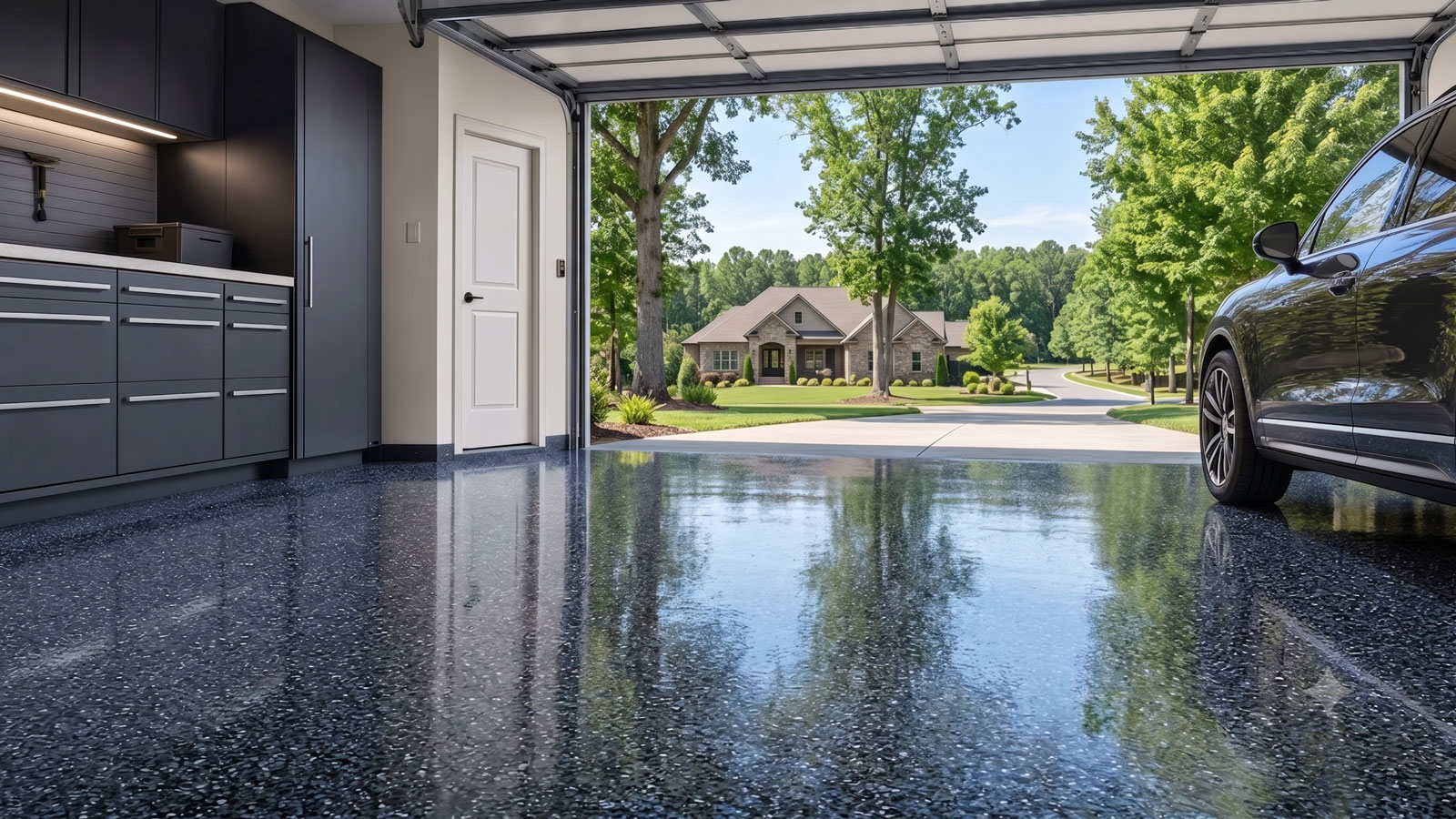
Garage Floor Coating in Leesburg, VA
Garage floor coating guidance for Leesburg homes, including detached homes, townhomes, storage areas, and practical concrete-preparation considerations.
Floor Coating Services in Leesburg
Leesburg's garage-floor conditions reflect both its older town core and rapid residential growth beyond it. The town's 2023 Virginia Community Flood Preparedness application describes Leesburg as founded in 1758, with a 12.4-square-mile footprint and nearly 49,000 residents in a 2021 estimate. A garage near the historic district may have been rebuilt or repoured long after the house, while a later attached bay in an expanding neighborhood may contain builder sealer and control joints. Those construction differences matter more to coating adhesion than the age of the town.
Leesburg's drainage evidence is unusually specific. The town reports Tuscarora Creek and Town Branch converging near a flood-prone area southeast of the historic district and documents 445 acres of major floodplain. A 2026 proposal considered changes to land uses near Town Branch between Wirt and Harrison streets. These are real planning issues, not proof that an individual homeowner's garage is wet. Actual driveway grade, threshold staining and slab condition remain decisive.
An epoxy, polyaspartic or decorative-flake finish can be a useful improvement on sound, properly prepared concrete. Ask about old coatings, cracking, moisture investigation where warranted, tight equipment access and how long a garage must remain out of service. A decorative coating is not a substitute for stormwater controls.
Local Market Insight
Leesburg's 2023 flood-resilience planning documents Tuscarora Creek and Town Branch, 445 acres of major floodplain and rapid historic-to-suburban growth. Those specific conditions warrant checking actual garage drainage and slab history, not assuming flood damage on every property.
What Affects the Cost of Garage Floor Coating in Leesburg?
A town-core garage with older paint and rear access can require more coating removal and staging than a later subdivision attached bay. Conversely, newer concrete can have curing sealer that needs removal before a resin system can bond.
Floodplain proposals for Town Branch are public land-use decisions, not slab-moisture tests. Separate any outside drainage corrections from stripping, grinding, stable crack repair and the complete finish layers.
- Historic and later concrete: Leesburg's older center and subsequent residential expansion have different garage forms. Check whether a floor was repoured, whether patches are sound and which coatings survive.
- Film removal and profiling: A historic-area garage might contain several paints, but a new-looking floor may retain curing compound. Inspect the actual surface and quote stripping, grinding and oil removal appropriately.
- Tuscarora and Town Branch context: Floodplain planning concerns mapped corridors, not automatic private moisture. Inspect the driveway's final grade, outside drains, water lines and any persistent damp patches.
- Cracks and repair edges: A spalled threshold or old repair differs from a designed control joint. The installer should explain which defects can be patched and which movement requires separate evaluation.
- Downtown access and staging: A tight town lot or side-entry garage may constrain grinding equipment, debris movement and temporary parking. Put those logistics explicitly into the scope.
- Winter and daily use: Road salt, tracked grit and rainwater affect traction and cleanability. Check coating layers, local installation conditions and manufacturer-specific vehicle-return timing.
Call for a clear, project-specific estimate — or request one online.
Historic Leesburg, Suburban Growth and the Concrete Behind the Door
Leesburg's own flood-resilience application provides useful context for its built environment: the town was founded in 1758 and grew from about 16,000 residents in 1990 to nearly 49,000 in 2021. That change includes historic-core preservation and suburban residential development. It does not establish that an older home's garage floor is original or that a newer subdivision bay is ready for resin coating.
Some historic-center properties have detached buildings with old paints, patchwork and narrow work areas. Another owner may have completely replaced the concrete after renovation. A later attached garage may be flat and apparently clean, but builder sealer, curing materials or previous epoxy can still interfere with bonding. Look for different slab textures, crack fillers, oil and door-edge deterioration during inspection.
Ask the installer to separate surface preparation from decorative material cost. An older garage reached by a tight driveway can need more staging or perimeter work than an open bay. A written estimate should address removal of previous finishes, mechanical profiling, treatment of stable cracking, moving joints, edges and access for grinders and debris.
Once the substrate is suitable, compare complete epoxy and polyaspartic systems. A decorative flake blend cannot make deteriorating concrete strong, and a rapid-cure claim does not remove the need to assess moisture and temperature. Leesburg homeowners benefit from a quote that describes their actual garage rather than a single standard floor size.
Tuscarora Creek, Town Branch and Garage-Level Flood Questions
Leesburg's 2023 Community Flood Preparedness application reports 445 acres of major floodplain, together with 151 acres of minor floodplain, and identifies a flood-prone confluence of Town Branch and Tuscarora Creek. In 2026 the town published proposed amendments affecting a specific Town Branch area between Wirt and Harrison streets. These official facts establish public flood-planning priorities, not the moisture condition of a garage elsewhere in Leesburg.
At the property, inspect the direction of runoff along the driveway and the relationship between roof leaders and the overhead door. Check whether water has actually crossed the threshold or if painted concrete remains damp after drying weather. A wet-car puddle is not evidence of a flood or vapor-transmission problem; neither problem should be diagnosed from a townwide map alone.
Even well-drained Leesburg garages receive winter road treatment residue, grit and slush. A continuous properly bonded finish can make cleaning easier than rough bare concrete, but residents still need to remove standing water and abrasive dirt. Texture and household parking timing may matter as much as appearance.
If water enters from outside, fix the drainage route or threshold before coating. If moisture within the slab is suspected, have the concrete assessed under the proposed coating system's requirements. Then specify grinding, contaminant removal, crack repairs, joints, layer sequence and vehicle-return timing. Public flood studies should direct better questions, not produce unsupported claims about an individual floor.
Frequently Asked Questions
Does Leesburg's 445-acre major floodplain mean my garage is wet?
No. It identifies mapped municipal exposure, not a test of a private floor. Check the actual parcel, driveway grade, door, past water entry and slab before deciding whether drainage or moisture work is needed.
Are garage slabs in historic Leesburg necessarily old?
No. A garage can be added or repoured long after a house was built. The existing paint, sealers, repairs and concrete soundness are more relevant to preparation.
Can epoxy keep Town Branch runoff from entering a garage?
No. A decorative system cannot redirect exterior water. Resolve drainage, grade or threshold problems and then evaluate whether the slab can accept a coating.
What belongs in a Leesburg quote?
Look for old-film removal, mechanical profiling, crack and joint handling, door-edge repairs, appropriate moisture checks, complete system layers, traction, equipment access and manufacturer-based parking return.
How should I maintain a coated garage through winter?
Sweep abrasive grit and remove salty meltwater and puddles. A sound coated floor can simplify cleaning but does not eliminate seasonal maintenance or outside drainage obligations.
Leesburg Neighborhoods & Local Context
Phone Quote Line
Talk through the floor condition, coating options, and practical pricing range for your project.
(571) 500-4090Typical Project Cost
$3,000–$5,500
$3,000–$5,500 for a typical two-car garage. Final pricing depends on floor size, concrete condition, prep work, coating type, and finish options.
Other Service Areas